SEC536: Adversarial AI - Penetration Testing AI Systems
SEC536Offensive Operations, Artificial Intelligence


All of DFIR. One Event.
DFIR | Ransomware | Threat Hunting
Need approval to attend?
Download a ready-to-use letter that makes the case to your manager.
Download the letterReal investigations, emerging research, and practical DFIR tradecraft.
Practice today’s DFIR tools and investigative techniques.
Compare approaches and tackle hard problems with fellow practitioners.

Heather Barnhart
VP of Curriculum and Digital Forensics Expert
SANS Institute
Keynote
Idaho Murders Digital Evidence

Jason Higley
Founder and Principal
SG Consulting
Keynote
Digital Evidence Exposes Deception

Jenn Gile
Co-Founder
OpenSourceMalware
Threat Hunting Track
DPRK Developer Identity Attacks

Aidan Holland
Senior Security Researcher
Censys
DFIR Track
ClickFix and Odyssey Stealer

Ashwin Patil
Principal Security Researcher
Microsoft
DFIR Track
Cloud and AI Hijacking

Michał Sołtysik
Cybersecurity Consultant
Michał Sołtysik CyberWave
Ransomware Track
Ransomware EDR Blind Spots
Tammy Harper is a Senior Threat Intelligence Researcher at Flare, specializing in ransomware, cybercrime ecosystems, and the people behind them. Her research explores how threat actors build identities, form communities, establish trust, and operate across the dark web and underground cybercrime economy.
A special discounted rate of $289.00 S/D plus applicable taxes will be honored based on space availability. A limited number of Government Per Diem rooms at the prevailing rate are available with proper ID.
Self-parking with in and out privileges is discounted for SANS attendees at $20 per day for commuters and $30 per overnight.
The cut off date has passed, please reach out to bnix@sans.org for assistance in booking a reservation.







Check in at the registration desk to pick up your Summit credentials, then enjoy a hot breakfast, freshly brewed coffee, and a selection of hot teas before the day’s sessions begin. Be sure to visit the Solutions Expo to meet our Summit sponsors and explore the tools, services, and resources they offer.
In-Person
In-Person
NOTE: The Day 1 special case-study keynotes and featured discussion are available exclusively to in-person attendees and will not be broadcast or shared publicly.
Every contact leaves a trace. BK was a criminology graduate student who appeared to have left behind a remarkably limited digital footprint surrounding the November 13, 2022 murders of four University of Idaho students. For nearly a month, the investigation continued without an arrest. DNA evidence recovered from the crime scene ultimately helped lead law enforcement to BK, while surveillance footage of a vehicle provided another critical piece of the investigative puzzle. But the digital evidence told its own story.
In this keynote, Heather will dive into the digital logs, artifacts, and other evidence that helped investigators reconstruct events, establish connections, and build their case against BK. Through a DFIR lens, she will explore how seemingly small digital traces can become powerful pieces of a much larger investigation, and demonstrate why, even when someone appears to have minimized their digital footprint, the evidence left behind can still reveal a compelling story.
In-Person
NOTE: The Day 1 special case-study keynotes and featured discussion are available exclusively to in-person attendees. Only Jason Higley's presentation will be recorded and made available to all registered in-person and virtual attendees after the Summit on the Summit access page.
Every message has a sender, a recipient, and can have any number of service providers in between. Evidence can be found in all of these places; you just have to go looking. Ian Diaz was a Deputy U.S. Marshal who, with his wife Angela Connell, engaged in an elaborate scheme to create an online persona called "Lilith" that he used to frame his ex-fiancée Michelle Hadley for crimes she did not commit.
Diaz was a savvy criminal who used his law enforcement training, VPNs, and encrypted messaging apps. He destroyed evidence by deleting accounts and wiping devices. But to carry out a scheme like this on digital devices, you have to be perfect. Diaz wasn't.
In this keynote, Jason will discuss the forensic investigation and digital evidence that exposed Diaz's scheme and secured his conviction. He will show how the case was made, not with a single smoking gun, but by the accumulation of small, individual pieces of evidence — the grains of sand that eventually tipped the scale and established Diaz's guilt.
In-Person
NOTE: The Day 1 special case-study keynotes and featured discussion are available exclusively to in-person attendees and will not be broadcast or shared publicly.
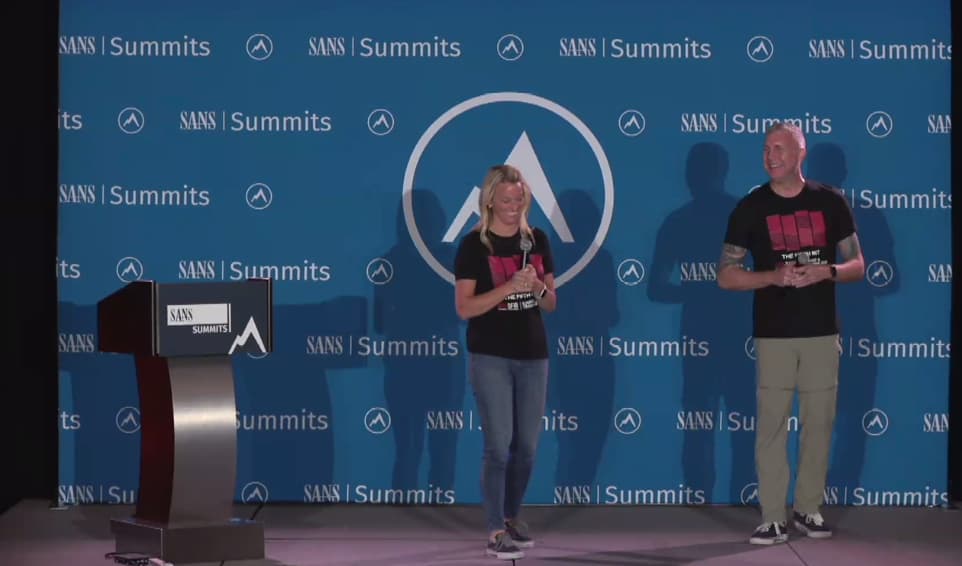
Following their back-to-back keynotes, Heather Barnhart and Jason Higley return to the stage to compare insights from their investigations, discuss the role digital evidence played in uncovering the truth, and ask questions of one another. The conversation will conclude with questions from the audience.
In-Person
Step away from the morning sessions to recharge and connect with fellow attendees. Enjoy coffee, tea, assorted soft drinks and juices, fresh fruit, and a featured snack.
In-Person
In-Person & Virtual
Vishing attacks targeting Google accounts have grown more sophisticated — not by breaking authentication systems, but by weaponizing them. This talk presents a forensic case study of a real, coordinated attack that combined display-name header spoofing with deliberate abuse of Google's account recovery notification infrastructure to deliver a fully authenticated, DKIM-signed Google security alert directly to the victim's inbox.
The attack began with a phone call impersonating Google Support, followed by two precisely timed emails. The first was a spoofed phishing lure — appearing as "support@google" while originating from attacker-controlled infrastructure at case-priority.com, relayed through MailChannels and Hostinger, with SPF passing on the envelope sender while the visible From header pointed to a non-existent domain. The second required no spoofing at all: the attacker added the victim's address as a recovery contact on a throwaway Gmail account, then triggered account changes — causing Google's own servers to send a legitimate security alert to the victim's inbox. The contrast between the two emails is forensically significant and operationally underappreciated.
Attendees will learn to identify SPF alignment failure behind a passing SPF result, read SMTP relay chains to surface attacker infrastructure, and distinguish display-name spoofing from envelope spoofing in raw headers. The talk concludes with a MITRE ATT&CK mapping of the full attack chain, header-level IOCs, and hardening recommendations for Google Workspace environments that DFIR practitioners can implement immediately.
In-Person & Virtual
Every ransomware investigation begins long before encryption. Success depends on recognizing the seemingly ordinary activity attackers use to establish access, move through an environment, and position themselves before launching the final stage of an attack. Using a real-world incident involving Fusion Computing, presenters reconstruct an identity-driven intrusion that was identified and contained before ransomware could be deployed.
Attendees will follow the investigation from an initial social engineering phone call through PowerShell execution, command-and-control activity, and living-off-the-land techniques that initially blended with legitimate administrative behavior.
Bryson demonstrate how endpoint telemetry, identity signals, and forensic artifacts were used to reconstruct the attack timeline, validate attacker activity, identify the evidence that mattered most, and prioritize containment decisions before encryption could occur. The session also examines how the observed techniques map to the MITRE ATT&CK framework, highlighting practical opportunities to improve visibility into identity-based attacks and strengthen threat hunting workflows.
Participants will leave with practical hunting techniques for detecting identity-driven intrusions, investigative approaches for validating attacker activity, and recommendations for strengthening ransomware detection before encryption begins.
In-Person & Virtual
Microsoft OneDrive Offline Mode stores significantly more than synchronized files. Modern versions of the client cache data from Outlook, Microsoft Teams, and SharePoint, creating a rich source of forensic evidence that is often absent from traditional acquisition and analysis workflows. Investigators who understand these artifacts can recover valuable context about user activity even when cloud access is unavailable.
This session provides a deep technical examination of OneDrive Offline Mode artifacts and demonstrates how to identify and analyze files associated with email, calendar events, meeting invitations, Teams chats, and SharePoint data. The presentation explains where these artifacts are stored, how they relate to one another, and techniques for reconstructing user activity across Microsoft 365 services.
The session also examines OneDrive's Optical Character Recognition (OCR) metadata, showing how text extracted from images and documents can become valuable investigative evidence while also introducing privacy and security considerations. Attendees will learn how OCR data is stored, what information can be recovered, and the implications for incident response, insider threat investigations, and enterprise data protection.
Using real artifacts and practical demonstrations, attendees will gain a repeatable methodology for locating, parsing, and correlating OneDrive Offline Mode data. They will leave with actionable techniques that can be immediately incorporated into forensic collections, artifact triage, and Microsoft 365 investigations.
In-Person & Virtual
When a manufacturing organization with two physical sites was compromised through an unpatched FortiGate 60E firewall running a vulnerable FortiOS 7.2.2 build affected by CVE-2022-42475, alongside a set of end-of-life Windows Server 2012 hosts, the incident response team uncovered far more than encrypted files. The environment had a fully flat network with switch loopbacks, no DHCP failover, and backups that had never been audited, meaning entire servers were missing from the backup set without anyone knowing.
This session walks through the full incident lifecycle: initial access through the unpatched firewall and legacy servers, confirmed data exfiltration alongside encryption, forensic preservation through full host imaging and triage collection before any remediation began, and the decision to pursue a decryptor rather than risk an estimated 50 percent data loss across the environment, including Active Directory.
Attendees will see the exact hardening checklist used across both sites, covering network containment, Active Directory and Kerberos resets, GPO and credential audits, and EDR plus anti-ransomware deployment, along with the specific gaps in the client's prior security posture that allowed the incident to happen in the first place.
This talk is built for both technical responders who want the operational detail and less technical attendees who need to understand how a single unpatched device cascades into a two-site recovery effort.
In-Person & Virtual
The most common root cause analysis seen in cases such as ransomware or business email compromise focuses mainly on the human aspect; a user clicked on a phishing link or opened a malicious document. From here, DFIR professionals close out the incident and move back into the day to day operations. This approach leaves a lot of unanswered questions;
what vulnerabilities were exploited, was there a process breakdown, how did factors such as identify and access management and EDR bypass play into this incident? Answering these questions requires a dedicated methodology and model for incident responders to properly identify preexisting conditions and failures so that future incident can be presented.
In this presentation, Gerard Johansen will be providing an overview of the Swiss Cheese Model of Root Cause Analysis. This model examines the various factors that aligned for an incident to occur. Instead of examining digital evidence for a single point of failure, this model looks at the entire chain of events, and identified how the holes in existing processes and configurations lead to the compromise.
This talk will examine the following high level topics:
In-Person & Virtual
Modern Endpoint Detection and Response (EDR) platforms heavily publicize their ability to block ransomware through real-time behavioral correlation, file-system telemetry, and API hooking. However, these detection layers rely on predictable heuristic metrics, such as high-frequency cryptographic API calls and linear directory traversing.
This presentation demonstrates how progressive structural changes can completely blind enterprise defenses without changing the operational outcome of a simulation. Through an iterative, 12-stage analysis of a purpose-built evaluation agent, we map exactly how signature scanners and behavioral engines fail when confronted with execution-delay jitter, directory-walk elimination, and user-space stream transforms.
We will reveal how shifting from standard API frameworks (like .NET CryptoStream) to custom, user-mode byte manipulation (ProcessFileStealth) easily neutralizes static heuristics. Furthermore, we demonstrate how avoiding recursive directory loops via flat enumeration techniques undercuts an EDR's correlation logic. Attendees will walk away with concrete data on engine blind spots and practical testing methodology to validate their own defensive posture against low-and-slow execution vectors.
In-Person & Virtual
Odyssey is a Malware-as-a-Service platform, and that changes how DFIR works. Developers host the infrastructure; affiliates pay for access and run their own campaigns. The affiliate who set the trap is a different actor from the operators running the backend, and attribution requires untangling both. This talk shows how.
Using forensic artifacts on the endpoint, network telemetry, and internet-wide scan data to identify the affiliate, map the full C2 fleet, and trace the platform's lineage from AMOS through Poseidon to Odyssey.
The case that gets us there: a user reports their cryptocurrency wallet has been drained. The Ledger Live app on their Mac "looked totally normal." Working a real incident from first call to final attribution, we trace Odyssey Stealer -- a macOS infostealer -- from the hidden LaunchDaemon on the victim's machine all the way back to the threat actor who ran the campaign. The path runs through a trojanized Ledger app, a cleartext password cached in a dotfile, a ClickFix fake CAPTCHA page the victim visited two weeks before the theft, and a polished React admin panel hosted on ten C2 servers across Europe and Russia.
Attendees leave with a concrete forensic artifact reference for Odyssey infections, a repeatable methodology for hunting MaaS C2 infrastructure from a single known host, and a clear-eyed picture of what "attribution" means when you're investigating a criminal SaaS.
In-Person & Virtual
"What data was taken?" is one of the first questions legal counsel asks during a ransomware engagement, and in most cases, it's the hardest question to answer. Rclone has become the de facto exfiltration tool used by ransomware affiliates: it's free, flexible, and quiet. Analysts typically fall back on firewall logs for a byte count however, this doesn’t tell us what has been taken.
This session demonstrates how to turn a memory image, which can be paired with a packet capture, into an inventory of exfiltrated files. It dissects what rclone leaves in memory, including execution artifacts, command line arguments, and the config file. These details include the deobfuscated remote location, which reveals the destination service, the account, and the master key. From the packet capture, the tool carves the encrypted uploaded blobs, collects the exact file sizes, and then correlates them with the memory artifacts, source directory listings, and file sizes. This session shows why capture timing affects what you can collect: account keys, file encryption keys, and transport keys. During this session, a free tool that automates this and formats the output for executives and legal counsel to help drive notification decisions as well as the limitations of this tool.
In-Person & Virtual
Join your fellow Summit attendees for a delicious lunch and an opportunity to connect. After lunch, visit the Solutions Expo to meet our Summit sponsors and explore the tools, services, and resources they offer.
In-Person
In July 2025, Check Point Research disclosed MCPoison (CVE-2025-54136, CVSS 7.2), a flaw in Cursor IDE (versions ≤ 1.2.4) where the Model Context Protocol trust model bound approval to an MCP server's name rather than its command or arguments. An attacker commits a benign .cursor/rules/mcp.json to a shared repository; a developer approves it once; the attacker later swaps in a reverse shell that runs silently on every project open — persistent RCE with no second prompt.
A companion flaw, CurXecute (CVE-2025-54135, CVSS 8.6), reached the same outcome through prompt injection that wrote to ~/.cursor/mcp.json and executed even after the user rejected the change.
These two incidents expose the problem this session tackles: when the acting entity is an AI agent, the authentication event is legitimate, the spawning process is the expected runtime, and the action falls within the agent's granted permissions so conventional EDR timelines show nothing anomalous, and the triggering instruction frequently lives only in ephemeral prompt context that does not survive default log retention.
The session reproduces both CVEs live on an isolated host, then contrasts their forensic footprints: MCPoison leaves recoverable on-disk evidence (git history of the config, file modification times, file-integrity-monitoring hits), while the prompt-injection path leaves almost nothing once the session closes. From that contrast the presenter derives a NIST-mapped incident-response playbook for agentic systems what to preserve before containment, how to triage runtime-escape versus privilege-boundary-escape versus reasoning-compromise incidents, and how to instrument MCP tool-call telemetry so the originating instruction is captured as evidence rather than lost.
Attendees leave with the lab build (vulnerable and patched configs), a forensic-artifact collection checklist for MCP and agent incidents, file-integrity-monitoring and detection logic for mcp.json tampering, and an open-source telemetry wrapper that records agent tool calls and their originating context in a retention-safe format.
In-Person & Virtual
Today more than ever, we are faced with the daunting task of protecting our environment and stopping attacks. At the same time, the adversary is getting smarter and more effective by the day. Given the plethora and disparity of attack surfaces, it can be a daunting task just trying to figure out how and where to get the artifacts from that will answer our questions.
Indeed, the very security inherent in devices today means that location, extraction, and parsing are no longer straightforward. Couple this with the data set sizes an analyst is faced with, and we quickly see that we need a different approach. This workshop will provide knowledge and hands-on training and guidance on collecting, extracting, and understanding the most important artifacts from a range of data repositories from RAM to storage to the Internet of Things. The goal is to take the analyst from data seizure to actionable intelligence in minutes, rather than the hours and sometimes days that it has traditionally taken.
In-Person
Enterprise data exfiltration rarely presents as a clear, high-confidence alert. Instead, investigators must determine whether observed activity reflects legitimate business use or policy-violating or malicious behavior using incomplete and often ambiguous telemetry. This session presents real-world DFIR investigations involving insider-driven data movement across removable media, email, and cloud channels, where initial detections alone were insufficient to determine risk or intent.
The talk examines multiple investigation patterns observed in enterprise environments, including long-duration accumulation of data to removable media, burst exfiltration events where most transfers occur within a short timeframe (such as hours preceding user termination), and multi-channel movement combining USB transfers, email forwarding to personal accounts, and cloud-sharing activity.
Additional scenarios include misuse of legitimate access (where data aligns with a user’s role but is accessed or transmitted outside expected context) and repeated low-volume transfers designed to evade threshold-based detections. Attendees will follow the investigation sequence used to expand alerts into full-scope cases, including correlating endpoint telemetry such as DeviceFileEvents for removable media activity, email telemetry such as EmailEvents and attachment metadata, and identity signals related to account activity and user lifecycle changes. The session demonstrates how investigators perform historical lookbacks, validate data sensitivity through targeted sampling, and establish behavioral baselines to identify anomalies in volume, timing, and access patterns.
The presentation highlights a critical limitation in traditional DFIR workflows: activity-based detections alone cannot distinguish between legitimate use and data exfiltration without contextual and behavioral analysis. To address this, the session introduces a repeatable investigation methodology that includes classification of exfiltration patterns (slow accumulation, burst transfer, and multi-channel movement), a correlation framework linking endpoint, email, and cloud telemetry, and a decision model for assessing user intent in ambiguous scenarios.
Attendees will leave with practical, directly applicable outputs, including an investigation checklist for multi-channel data movement, behavioral indicators for identifying suspicious activity, and detection and correlation approaches that can be adapted within platforms such as Microsoft Defender XDR or similar environments.
In-Person & Virtual
This talk will delve into a highly sophisticated Chinese APT campaign, tracked as CL-STA-0049, that has been targeting governments, defense, telecommunication, education and aviation sectors in Southeast Asia and South America since at least March 2023. This campaign demonstrates a high level of complexity, utilizing a multi-stage attack chain and employing advanced evasion techniques to bypass traditional security measures.
At the heart of this operation lies "Squidoor", an advanced backdoor exemplifying evolving state-sponsored tactics. This sophisticated backdoor features both Windows and Linux versions, employing an unprecedented array of 10 different C2 communication methods, including rarely seen techniques like abusing Outlook for C2 communication.
In the presentation, we will first share the different TTPs the threat actor used to gain access to the victim network and deliver the "Squidoor" malware.
Second, we will provide a thorough and detailed technical malware analysis of the "Squidoor" malware. We will begin with the execution flow of the malware involving LOLBAS and shellcode. Next, we will dive into the 10 different C2 communication methods Squidoor is able to utilize and explain how they work. And finally we will touch upon Squidoor's different capabilities and encryption protocols it's utilized as part of the c2 communication.
We will end the presentation with giving the audience practical ways to hunt for the Squidoor malware. By the end of the talk, attendees will gain a unique glimpse into the inner working of sophisticated Chinese APT tooling and operations.
In-Person & Virtual
Step away from the afternoon sessions to recharge and connect with fellow attendees. Enjoy coffee, tea, assorted soft drinks and juices, fresh fruit, and a featured snack. Be sure to visit the Solutions Expo to meet our Summit sponsors and explore the tools, services, and resources they offer.
In-Person
An international consulting firm detects suspicious outbound traffic from a financial analyst’s workstation. Initial alerting suggests unauthorized access to internal document repositories. As the investigation begins, incident response uncovers signs of a coordinated intrusion campaign affecting multiple hosts across the network.
Over the course of this instructor-guided simulation, attendees will step into the role of a response team working through a multi-phase intrusion. The case begins with initial access via a malicious backdoor, escalates to persistence and credential abuse, and culminates in lateral movement and data exfiltration.
Analysts will be given evidence files and access to all affected systems, and they’ll work to reconstruct the full attack chain, identify compromised accounts, and map the attacker’s path across the enterprise.
Learning Objectives:
By the end of this simulation, attendees will be able to:
In-Person
This hands-on session will take you through a detailed FOR589 lab focusing on the complexities of cybercrime infrastructure. You will dive into the critical types of infrastructure indicators—Atomic, Behavioral, and Computed—and their roles in detecting and understanding cybercrime activities. Learn about the pivotal role that domains, IP addresses, and email accounts play as Atomic Indicators, and understand how Infrastructure-as-a-Service (IaaS) helps in identifying the ownership of these indicators.
The workshop includes practical exercises where you will use advanced fingerprinting techniques not only to identify but also to predict cybercrime behaviors. This approach will enhance your skills in analyzing and countering cyber threats.
Learning Objectives:
Prerequisites:
This workshop consists of a series of practical exercises designed for cybercrime investigators or researchers looking to enhance their skills in analyzing criminal infrastructure. Participants should have a problem-solving mindset and be open to learning new methods for investigating cybercrime. The technical prerequisites for this workshop are minimal, making it accessible for those with a basic understanding of cybersecurity concepts.
In-Person
After a full day of DFIR insights, join us at the SANS FIND EVIL Evening Social, hosted at the Continental Pool Lounge. Enjoy FIND EVIL-themed drinks and food, play pool, table tennis, shuffleboard, darts, or classic arcade games, all while connecting with fellow attendees, speakers, and SANS experts.
In-Person
Check in at the registration desk to pick up your Summit credentials, then enjoy a hot breakfast, freshly brewed coffee, and a selection of hot teas before the day’s sessions begin.
In-Person
In-Person & Virtual
In-Person & Virtual
Traditional endpoint detection and response (EDR) agents are powerful, but what happens when threat actors bypass them entirely by spinning up their own unmanaged systems within your hypervisor? Unit 42 investigated a complex intrusion where the notorious threat group Scattered Spider (aka Muddled Libra, UNC3944) did exactly that.
After leveraging social engineering to gain administrative credentials, the threat actors accessed the victim's VMware vSphere portal, created an unmanaged rogue virtual machine, and utilized it as an operational beachhead to conduct actions on objectives.
Fortunately, the security team terminated the attackers' access before they could delete the rogue VM, leaving behind a highly valuable forensic record. This presentation delivers a forensic reconstruction of Scattered Spider’s active playbook built directly from the artifacts recovered from that beachhead system. We will walk through the exact 15-hour timeline, detailing the group's living-off-the-land tradecraft and distinct troubleshooting behaviors.
Attendees will learn the technical mechanics of:
• Establishing persistence using an SSH tunnel hosted in an attacker-controlled AWS S3 bucket.
• Disabling and powering down virtualized domain controllers via vSphere, mounting their VMDK disks, and copying the NTDS.dit database and SYSTEM registry hive to decrypt and harvest domain-wide credential hashes.
• Executing Active Directory enumeration tools, and specifically targeting various computing services to map critical infrastructure.
• Navigating SaaS cloud databases and attempting to exfiltrate sensitive Outlook PST files via the S3 Browser tool.
We will also analyze the threat actor's real-time struggles documented in their browser history: searching Bing for how to bypass blocked file-sharing sites, troubleshooting Outlook speed issues, and researching how to find older Outlook versions on Reddit.
In-Person & Virtual
Step away from the morning sessions to recharge and connect with fellow attendees. Enjoy coffee, tea, assorted soft drinks and juices, fresh fruit, and a featured snack.
In-Person & Virtual
AI-assisted IDEs and coding tools are becoming part of normal developer workstation activity, but most DFIR playbooks still treat them as background applications rather than forensic evidence sources. This creates a visibility gap during developer compromise and software supply chain investigations: responders may see file changes, package installs, or repository activity, but miss the local session context, tool activity, workspace state, and configuration that explain how those actions occurred.
This session presents a DFIR-focused artifact study of AI-assisted developer environments such as VS Code with GitHub Copilot, Cursor, Claude Code, Codex, and related IDE- or terminal-based coding assistants. The research will compare the local traces these tools can leave behind, including session history, workspace context, prompts, tool outputs, command traces, debug logs, extension data, configuration files, local observability records, and repository-level instructions. It will also examine how these environments intersect with traditional attacker targets such as environment variables, API tokens, SSH keys, credential stores, package-manager credentials, and source-control authentication.
The talk will map these artifacts to realistic investigation scenarios involving malicious packages, suspicious editor or extension behavior, credential exposure, risky activities, and downstream CI/CD abuse. The focus will be on how these artifacts can be parsed, what important activity can already be observed through current EDR, endpoint, editor, source-control, and enterprise telemetry, and where visibility gaps remain for responders investigating compromised developer workstations.
The session will also discuss open-source tooling opportunities to make this analysis easier: lightweight collectors, artifact parsers, timeline builders, and triage helpers focused on AI-assisted developer environments. Attendees will leave with a practical artifact map, telemetry checklist, monitoring considerations, and investigation ideas for developer workstations that may serve as an initial access path into the software supply chain.
In-Person & Virtual
In 2026, DPRK campaign "PolinRider" compromised over 6,000 GitHub repos and 2,100 individuals by weaponizing trusted developer identities and workflows. It represents the industrialized next phase of Contagious Interview, turning crypto-theft hiring scams into a persistent pipeline that converts individual developer compromises into mass software supply-chain propagation.
Our research indicates many victims didn't just get hit once and recover. Rather, a meaningful subset remained compromised or became re-compromised over time, giving DPRK a long-lived pool of developer endpoints, credentials, and GitHub identities. This talk covers how PolinRider works and core detection engineering techniques you can use to hunt and identify these attacks.
In-Person & Virtual
The Apple Unified Log has become a critical forensic artifact that DFIR analysts leverage when investigating compromised Apple devices. However, the binary structure format of the Unified Log is undocumented by Apple and remains a black box for many analysts and users. This forces analysts to rely on native Apple tooling. To better understand how a log message is assembled, we must understand how the log message is reconstructed from fragmented data across a system.
This talk will be a deep dive into the binary structure of the Apple Unified Log format and a walkthrough of the three binary components of the Unified Log. We will discuss each binary file format and how each component leverages each other in order to assemble a full log message. In addition, the talk will discuss some challenges that may be encountered when parsing the log formats.
Finally this talk will discuss a cross-platform, open-source Rust library designed to parse the Apple Unified Log files.
In-Person & Virtual
Identity has become one of the most targeted attack surfaces in modern enterprises. Instead of stealing passwords or deploying malware, attackers increasingly obtain valid OAuth access tokens and reuse them to move through SaaS applications and cloud environments. Unfortunately, many organizations lack the telemetry and detection logic needed to identify token abuse before it results in account compromise.
This session demonstrates how defenders can hunt for OAuth token theft and replay using identity provider logs, API telemetry, cloud audit logs, and endpoint evidence. Through realistic attack scenarios—including token replay, bearer token theft, and OAuth redirect abuse—attendees will learn how to build hunting hypotheses, identify meaningful indicators, and create practical detections.
The presentation includes example KQL and Sigma detections, recommended logging sources, ATT&CK mappings, and a reusable hunting playbook that attendees can adapt to Microsoft Entra ID, Okta, Google Workspace, and other identity platforms.
In-Person & Virtual
Cyber-enabled financial crimes rarely begin with sophisticated malware or advanced intrusion techniques. More often, they begin with trust. This presentation examines a real-world investigation that started with a carefully crafted social engineering campaign and phishing attack that successfully deceived the victim, resulting in unauthorized access to accounts, compromise of digital assets, and the theft of cryptocurrency.
What initially appeared to be a routine phishing incident rapidly evolved into a complex, multi-stage investigation involving digital forensics, attack reconstruction, blockchain intelligence, asset tracing, legal coordination, and international cooperation.
The session follows the complete investigative timeline from the initial victim report through the final operational outcome. Attendees will learn how investigators reconstructed the attacker’s actions, identified key forensic artifacts, analyzed compromise indicators, and established a timeline of events from the initial social engineering contact to the unauthorized transfer of digital assets.
The presentation will demonstrate how technical evidence collected from compromised systems, transaction records, and digital artifacts was correlated to identify investigative leads and support attribution efforts. Particular focus will be placed on the challenges investigators faced while tracing stolen cryptocurrency through multiple transfers intended to obscure ownership, frustrate analysis, and delay recovery efforts.
Attendees will also gain insight into the operational realities of cryptocurrency investigations, including evidence preservation, blockchain analysis methodologies, attribution challenges, cross-border information sharing, and the integration of forensic findings into judicial processes.
The investigation ultimately resulted in the identification of the suspect, the freezing of criminally controlled digital assets, the recovery of assets associated with the offense, the issuance of judicial orders, and the successful apprehension of a suspect located outside the victim’s jurisdiction through established legal procedures. Rather than presenting a success story alone, this session provides a practical and repeatable investigative framework for DFIR practitioners, cybercrime investigators, analysts, and law enforcement professionals.
Attendees will leave with actionable methodologies for investigating cryptocurrency-enabled crimes, tracing digital assets, supporting recovery operations, and transforming technical findings into operational outcomes.
In-Person & Virtual
Hypothesis-driven hunting is often presented as a process of generating hypotheses and translating them into hunt queries. In practice, the most difficult part begins after the query runs. A single hunt can return thousands or tens of thousands of events, leaving analysts to manually baseline activity, identify outliers, and determine which findings deserve investigation.
This presentation shares lessons learned from building and deploying a production LLM-agent workflow focused on hunt execution and analysis. Rather than stopping at query generation, the system assists analysts throughout the investigation process by iteratively refining hunt results, building behavioral baselines, clustering similar activity, identifying anomalies, and surfacing the most promising leads for human review.
The talk walks through a complete threat hunting case study, showing how an initial broad hunt query evolves through multiple stages of automated analysis. Attendees will see how specialized agents perform result triage, compare activity against environmental baselines, identify unusual patterns, generate investigative pivots, and summarize findings with supporting evidence. The workflow is demonstrated against real security telemetry and production hunting scenarios.
The presentation also examines the challenges encountered in practice, including weak baselines, hallucinated conclusions, inconsistent results across model versions, and analyst trust. We discuss the safeguards implemented to ensure findings remain explainable, evidence-based, reproducible, and subject to analyst validation.
Attendees will leave with a practical framework for using LLM agents to augment hunt execution, reduce manual triage effort, and help analysts focus on the most suspicious activity without sacrificing transparency or investigative rigor.
In-Person & Virtual
Modern SOC and threat hunting workflows are increasingly augmented by large language models for alert triage and hypothesis generation, yet these systems remain unreliable in practice. They frequently produce confident but incorrect classifications, including overestimating routine activity as active compromise, mislabeling benign scheduled operations as command-and-control behavior, and incorrectly mapping post-exploitation or vulnerability exploitation stages.
For example, legitimate enterprise behavior such as backup jobs running at 2 AM may be incorrectly interpreted as beaconing or data exfiltration patterns. These hallucinations increase analyst workload, inflate false positives, and introduce operational risk by obscuring real threats.
This presentation introduces a self-correcting AI threat hunting pipeline designed to address these limitations through structured feedback, institutional context modeling, and persistent learning. A key extension of this work is the concept of *institutional benchmark engineering*, where organizations define their own environment-specific ground truth. This allows security teams to encode what “normal behavior” looks like in their own infrastructure, for example, scheduled backups, patch deployments, or batch ETL jobs so that these are not misclassified as malicious activity.
The system is evaluated on a custom benchmark of 30 realistic security scenarios derived from publicly documented attack patterns and detection use cases.(CISA KEV and NVD CVE) Each scenario includes structured ground truth for severity, recommended response action, and MITRE-aligned attack categorization.
A baseline evaluation using Gemini-2.0-Flash achieved 33.3% accuracy, revealing significant weaknesses across severity classification, response action selection, and attack categorization. The system then applies a persistent learning loop that captures failures, stores them as structured JSON memory, and generates targeted course corrections that evolve the prompt across iterations.
Following a single learning cycle, performance improved to 96.7% accuracy, reducing failures from 20 scenarios to a single remaining error. The loop injected 43 targeted corrections addressing systematic issues such as DDoS over-classification, infiltration mislabeling, and incorrect remediation actions.
The session walks through the full architecture, including benchmark design, institutional baseline modeling, failure-memory construction, automated correction generation, and iterative prompt evolution. It also demonstrates how organizations can continuously refine detection intelligence by embedding site-specific operational context directly into evaluation benchmarks, thereby reducing hallucinations without model retraining.
Attendees will receive:
• Full open-source Python implementation of the persistent learning loop
• Framework for building institutional SOC benchmarks tailored to enterprise environments
• Benchmark generation pipeline with KEV-derived scenarios
• Failure-memory and correction injection patterns for self-improving SOC workflows
• Prompt engineering strategies for deploying self-correcting AI in security operations
This talk provides practical methods for detection engineers and threat hunters to systematically evaluate, contextualize, and improve the reliability of AI-driven security decisions before operational deployment.
In-Person & Virtual
Join Mari DeGrazia, Ovie Carroll, and Ray DePalma for a lively discussion about the promise and potential pitfalls of AI in DFIR, moderated by Heather Barnhart. Bringing different perspectives to this important question, the panelists will explore where AI can strengthen investigations, where it may introduce new risks, and what its growing role could mean for the future of the field.
In-Person & Virtual
Traditional MITRE ATT&CK coverage assessments typically treat detections as binary, asking only whether an analytic exists for a given technique. This approach fails to capture whether a detection is resilient to implementation variations, adversary evasion, or alternative attack paths. As part of MITRE CTID's Summiting the Pyramid initiative, the presenters developed an "effective coverage" calculator that evaluates detection quality by measuring how well analytics perform across multiple technique implementations and how robust they remain against adversarial evasion opportunities.
This session will present the research methodology behind the calculator, including the introduction and analysis of ATT&CK technique implementations, robustness and precision evaluation, and the framework used to quantify effective detection coverage. The presenters will demonstrate the calculator tool against a variety of Elastic and Sigma analytics and apply it to a real-world 2020 intrusion case study, showing how the methodology identifies gaps that traditional ATT&CK coverage metrics fail to expose and helps prioritize improvements to existing detections. Attendees will leave with a practical framework for evaluating detection effectiveness beyond binary ATT&CK coverage, access to the effective coverage calculator, and guidance for applying the methodology to improve detection engineering and threat hunting programs within their own environments.
In-Person & Virtual
Join your fellow Summit attendees for a delicious lunch and an opportunity to connect. After lunch, visit the Solutions Expo to meet our Summit sponsors and explore the tools, services, and resources they offer.
In-Person
When Protocol-SIFT was first released, it had no support for Linux investigations. In the process of adding Linux support, we learned a great deal about the strengths and pitfalls of using AI in DFIR. In this workshop, attendees will see how Protocol-SIFT can accelerate Linux investigations, while also learning how to recognize and handle hallucinations (false positives), missed evidence (false negatives), and the inherent non-determinism of AI, which complicates repeatability in forensic workflows. Participants will work hands-on with Protocol-SIFT (with Linux support) against real system and memory images to explore these challenges and opportunities in depth.
In-Person
A large majority of ransomware incidents involve both obfuscated scripts and Cobalt Strike. PowerShell reigns supreme as the most common type of obfuscated script found in ransomware cases. Do you know what to do should you find an obfuscated PowerShell script during response? What if you run into an obfuscated, PowerShell-based Cobalt Strike downloader?
Do you know how to decode the downloader? Do you know how to review the shellcode found multiple levels within the code structure to determine where the Cobalt Strike beacon is being hosted?
Come join SANS "FOR528: Ransomware for Incident Responders" author Ryan Chapman as he walks you through one of our FOR528 labs that shows you these very skills. You will use a virtual machine custom developed just for this workshop to review obfuscated code from real FOR528 labs. As a bonus, you will also learn how to extract the configuration from a Cobalt Strike Beacon. The better you are at performing these tasks yourself, the quicker you'll be able to derive additional TTPs and IOCs to assist in your overall response. Come learn HANDS-ON!
In-Person
Somewhere in a month of ordinary network traffic, an intruder is moving data out, and they look just like everyone else. In this workshop, a preview of the new SANS FOR668: Threat Hunting and Data Analysis, you'll learn baseline hunting and then use it to run them down.
Start from a ready-made baseline, find the flow that doesn't fit, pivot into a second log source to prove what happened, and make the escalation call.
Laptops required; the lab environment and dataset are provided.
In-Person
Step away from the afternoon workshops to recharge and connect with fellow attendees. Enjoy coffee, tea, assorted soft drinks and juices, fresh fruit, and a featured snack.
In-Person
Enjoy a hot breakfast, freshly brewed coffee, and a selection of hot teas before the day’s classes begin.
In-Person
GIAC Certifications is a leading provider of information security certifications, testing and validating expertise in cyber defense, penetration testing, forensics, software security, management, and industrial control systems (ICS). This session will focus on the benefits of certification and provide practical exam preparation tips to help candidates succeed.
Join Conan Beach—Special Agent with the U.S. Government, SANS Certified Instructor Candidate, and lead instructor of SANS FOR589: Cybercrime Investigations—for a candid look at what it actually takes to prepare for and pass a GIAC exam. Conan holds four GIAC certifications himself (GCFE, GPEN, GCIH, and GSEC), so he'll share the study strategies and index-building techniques that got him through each one.
Join the session to hear about:
In-Person
Registration:
About DFIR NetWars: Focused on digital forensics, incident response, threat hunting, and malware analysis, this tool-agnostic approach covers everything from low-level artifacts to high-level behavioral observations.
Computer Requirements: Laptop/desktop-based
Extra Requirements: Files downloads are required to participate.
Recommended For: Experienced Digital Forensic Analysts, Forensic Examiners, Media Exploitation Examiners, Malware Analysts, Incident Responders, Threat Hunters, Security Operations Center (SOC) Analysts, Law Enforcement Officers, Federal Agents, Detectives, and Cyber Crime Investigators.
Disciplines: Digital Forensics, Incident Response.
Example Topics:
Interactive Scenario: As a DFIR specialist, you are provided with evidence files from a series of mysterious compromised systems and conventional computing environments. Your mission? Use your DFIR skills to shed light on attack vectors, indicators of compromise, and other evidence needed to resolve the incident.
In-Person & Virtual
Registration:
About DFIR NetWars: Focused on digital forensics, incident response, threat hunting, and malware analysis, this tool-agnostic approach covers everything from low-level artifacts to high-level behavioral observations.
Computer Requirements: Laptop/desktop-based
Extra Requirements: Files downloads are required to participate.
Recommended For: Experienced Digital Forensic Analysts, Forensic Examiners, Media Exploitation Examiners, Malware Analysts, Incident Responders, Threat Hunters, Security Operations Center (SOC) Analysts, Law Enforcement Officers, Federal Agents, Detectives, and Cyber Crime Investigators.
Disciplines: Digital Forensics, Incident Response.
Example Topics:
Interactive Scenario: As a DFIR specialist, you are provided with evidence files from a series of mysterious compromised systems and conventional computing environments. Your mission? Use your DFIR skills to shed light on attack vectors, indicators of compromise, and other evidence needed to resolve the incident.
In-Person & Virtual