SEC536: Adversarial AI - Penetration Testing AI Systems
SEC536Offensive Operations, Artificial Intelligence

Experience SANS training through course previews.
Learn MoreLet us help.
Contact usBecome a member for instant access to our free resources.
Sign UpWe're here to help.
Contact UsThis is the second installment in a three-part series examining the SANS Leadership Triads and the distinct leadership capabilities each archetype develops.

When security programs struggle, it isn’t because their leaders lack intent. Programs are often hindered because execution degrades in predictable ways. Controls exist on paper, but drift across environments. Vulnerability queues grow faster than teams can remediate, and then prioritization becomes inconsistent. Incidents expose coordination gaps that were invisible when everything was running normally. The organization stays busy and still accumulates exposure.
The SANS Leadership Triads were designed to help alleviate this reality. Each triad structures three leadership courses around a core dimension of senior security work: leading transformation, leading operations, and leading risk mitigation. The first installment of this series focused on transformational leadership, which encompasses building the context, strategy, and cultural foundation required to align security with business priorities.
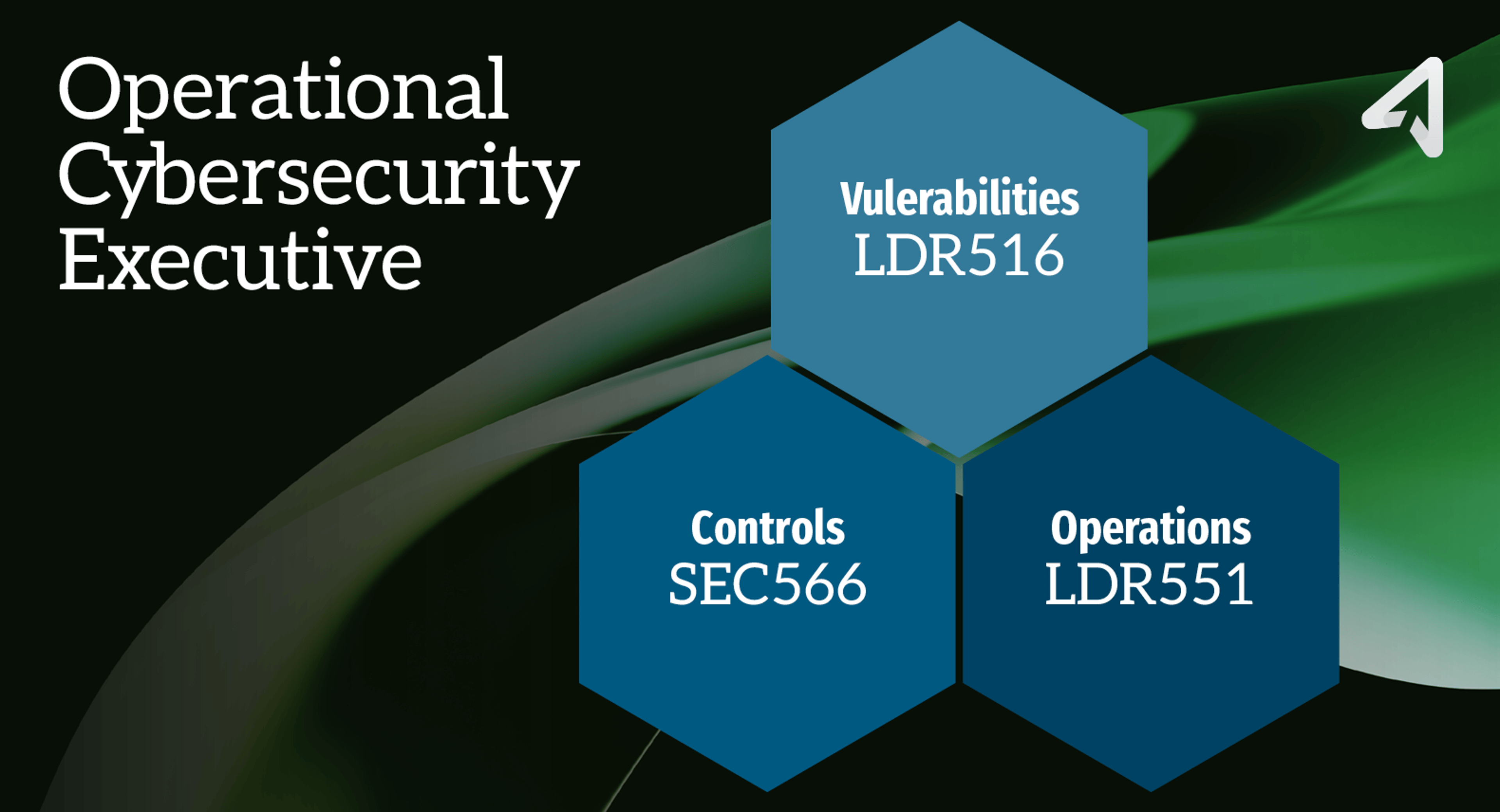
While transformational leadership is critical, it does not substitute for operational performance. This is why the second archetype of the SANS Leadership Triads is the Operational Cybersecurity Executive. Anchored by SEC566, LDR516, and LDR551, the second triad enables SANS students to strengthen three foundational skills that must work together: a control baseline that holds across the enterprise, exposure management that reflects threat and impact, and incident leadership that functions under stress. Developing this operational capability is what enables leaders to translate strategy into consistent security outcomes that ensure their organization remains protected.
Most security leaders can point to a number of security frameworks they’ve adopted. However, fewer can prove consistent implementation. The implementation failure pattern is usually the same. Controls are documented and approved, then applied unevenly across business units, platforms, and teams. Exceptions get granted, then never revisited. Ownership becomes implicit instead of explicit. Validation becomes occasional instead of routine. The organization ends up with a control posture that sounds mature and behaves inconsistently.
Control discipline requires operational definition. Which controls matter most against common attack paths? Who owns implementation? What evidence demonstrates effectiveness? How often is validation performed? How are exceptions handled so they don’t become permanent holes in the environment? Without clear answers, controls degrade into aspirational plans and security leaders lose credibility when incidents still occur.
SEC566: Implementing and Auditing CIS Controls builds this capability through implementation rigor. The course ties the CIS Controls to real-world attack patterns and forces operational thinking: how to implement controls in measurable ways, how to validate them through auditing and evidence, and how to maintain consistency across changing environments. A leader who can speak in terms of control effectiveness — rather than policy intent — has a fundamentally stronger operational foundation to build on.
Vulnerability data is abundant. Decision clarity is scarce. Many vulnerability programs end up managing volume. Metrics focus on counts, closure rates, and aging tickets. That activity can look productive while exposure remains high. Without integrating threat context and business consequence, the program becomes reactive — driven by whichever vulnerability is loudest, newest, or easiest to close.
Prioritization requires a consistent model. Risk is not a single variable. It reflects impact, vulnerability, and threat interacting together. A high-severity vulnerability can be low priority if it sits on a low-value system with limited exposure. A medium-severity weakness can be urgent if it maps to an actively exploited pathway and affects a business-critical process. Leaders need to be able to defend those calls, because remediation capacity will always be limited and product delivery will always compete for the same engineering time.
LDR516: Strategic Vulnerability and Threat Management Systems strengthens the shift from vulnerability tracking to exposure management. The course focuses on building programs that incorporate threat intelligence, asset criticality, and realistic remediation constraints into a defensible prioritization process. The output is a program leaders can run, not a dashboard leaders can stare at: clearer queues, fewer arbitrary escalations, and remediation effort applied where it reduces meaningful exposure rather than chasing throughput.
Incidents are where operational assumptions break. In a steady state, it’s easy to confuse tooling with readiness. Under pressure, the gaps show up quickly: unclear escalation paths, inconsistent triage standards, overlapping responsibilities, and slow cross-team coordination. Detection may work and response still fails because decision ownership is unclear or communication degrades when the tempo increases.
Operational leaders treat detection and response as part of a system, not a standalone function. Incident learning should flow back into control improvements and exposure prioritization. If incidents remain isolated events that are contained and closed without structural improvement, the organization repeats the same failures. Resilience comes from feedback loops: detection improves, controls harden, exposure priorities adjust, and response becomes more coordinated over time.
LDR551: Building and Leading Security Operations Centers builds the leadership capability required to run security operations as an integrated function. The course covers SOC governance, detection engineering practices, escalation models, response coordination, and performance measurement that reflects outcomes rather than noise. The emphasis is operational leadership: creating clarity under stress, sustaining the response capability through surge conditions, and ensuring incidents drive durable improvements rather than temporary fixes.
Operational resilience is engineered. It depends on control reliability, exposure prioritization grounded in context, and incident leadership that performs when conditions degrade. The Operational Cybersecurity Executive triad strengthens those capabilities directly. SEC566 reinforces measurable control implementation. LDR516 builds exposure management that integrates threat and impact. LDR551 develops coordinated security operations leadership and response governance. Together, these courses move organizations away from reactive execution and toward sustained operational performance.
Learn more about SANS’s Leadership Training curriculum here.
SANS Fellow Frank Kim helps to develop the next generation of CISOs and cyber leaders while teaching LDR512 and LDR514.
Read more about Frank Kim