SEC536: Adversarial AI - Penetration Testing AI Systems
SEC536Offensive Operations, Artificial Intelligence

Experience SANS training through course previews.
Learn MoreLet us help.
Contact usBecome a member for instant access to our free resources.
Sign UpWe're here to help.
Contact UsThis is the first installment in a three-part series examining the SANS Leadership Triads and the distinct leadership capabilities each archetype develops.

What it means to lead in cybersecurity has changed. For years, security leadership was defined by technical authority. Success meant implementing controls, reducing vulnerabilities, and responding to incidents. The function operated largely within IT, and performance was measured in operational terms: uptime, remediation rates, audit findings closed.
That operating model no longer reflects the responsibility carried by today’s leaders. Cyber risk now intersects directly with revenue growth, regulatory exposure, product timelines, and brand trust. Security leaders are expected to influence enterprise decisions, defend investment priorities in financial terms, and maintain resilience as organizations scale. The conversation has moved beyond control implementation. It now centers on consequence, tradeoff, and accountability.
This expansion in scope requires expanded capability. Technical depth remains essential, but it is no longer sufficient. To support leaders operating at this level, SANS developed the Leadership Triads — three structured groupings of leadership courses aligned to the distinct dimensions of modern cyber leadership: transformation, operational execution, and enterprise risk governance. Each triad reflects how senior security roles function in practice, not in theory.
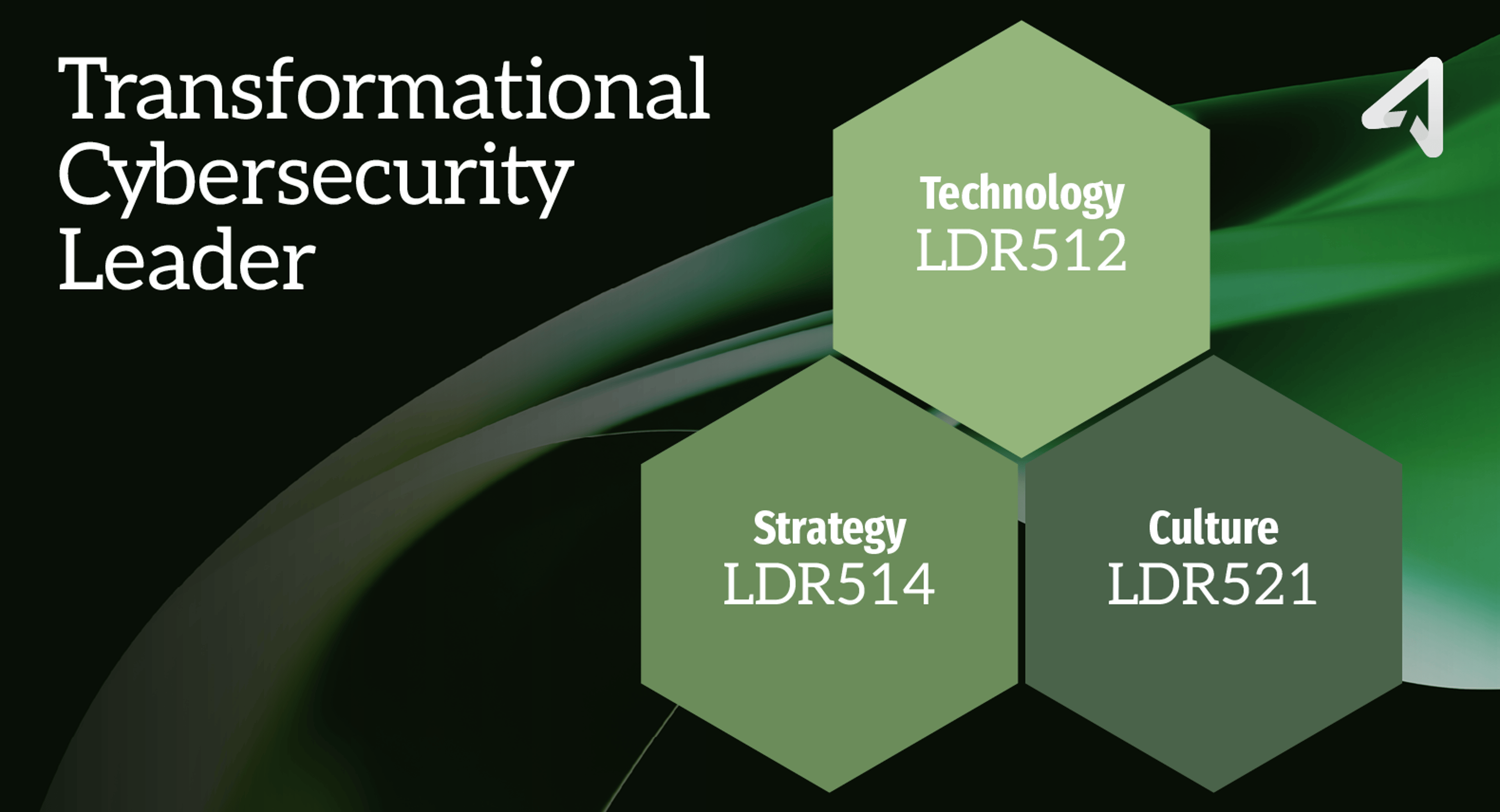
The first archetype in the SANS Leadership Triads is the Transformational Cybersecurity Leader. Anchored by LDR512, LDR514, and LDR521, it captures a structural shift in the role: security leaders are expected to influence decisions early, align risk with enterprise strategy, and build programs that scale beyond individual expertise.
Many leaders discover a hard truth as their scope expands: depth in one domain does not automatically translate into enterprise-wide perspective. A leader who built their career in application security may understand code review and threat modeling in detail but lack fluency in detection engineering or cloud architecture tradeoffs. A compliance-focused leader may understand regulatory frameworks thoroughly but have limited exposure to operational response dynamics. These gaps often remain invisible until decisions begin spanning multiple teams and functions.
At the enterprise level, security capabilities are interdependent. Architecture choices affect operational resilience. Identity strategy influences cloud exposure. Detection design impacts vulnerability prioritization. Without structured exposure to these connections, leaders optimize locally rather than systemically.
LDR512: Security Leadership Essentials for Managers is designed to broaden that operating context. The course examines core security capabilities across the enterprise and how they intersect. Participants analyze what a mature security program requires, how capabilities map to risk, and where structural gaps typically emerge. This broader perspective improves tradeoff decisions, reduces silo-driven conflict, and strengthens cross-functional coordination. For leaders stepping into larger roles, expanding context is often the first structural requirement for transformation.
Security initiatives accumulate quickly. A new threat emerges. An audit surfaces deficiencies. A customer requires certification. A merger introduces new exposure. Over time, programs become collections of justified responses rather than coherent strategy. Many leaders recognize the need for a roadmap, but struggle to build one that withstands executive scrutiny. Technical justification does not automatically translate into capital allocation. A list of projects does not constitute strategy.
LDR514: Security Strategic Planning, Policy, and Leadership addresses this directly. The course focuses on the mechanics of building a defensible, enterprise-aligned security strategy. Participants conduct structured gap analysis to define current and target states. They build roadmaps grounded in risk, resource constraints, and organizational priorities. Business cases are explicitly tied to enterprise outcomes, not internal security logic. Risk is framed in terms executives can act on.
The shift is practical and measurable. Conversations move from “we need this control” to “here is the exposure, here are the tradeoffs, and here is the recommended course of action.” Leaders who complete LDR514 are better prepared to engage CEOs, CFOs, CIOs, and boards with clarity. They can defend prioritization decisions and articulate the relationship between cyber risk and business risk in a way that influences outcomes.
Even with expanded context and structured strategy, many programs remain fragile. They function because a small group of experienced individuals compensate for structural weaknesses. They understand informal escalation paths. They know where the real risk concentrations sit. They absorb ambiguity through institutional memory. However, the challenge here is that this model does not scale. As organizations grow, teams expand, turnover increases, and decision velocity accelerates. Security leaders cannot personally review every initiative or absorb every exception.
LDR521: Security Culture for Leaders focuses on embedding security into organizational behavior rather than relying on constant oversight. The course examines how governance structures, incentives, and accountability frameworks shape risk decisions across the enterprise. Leaders work through how to clarify ownership, distribute decision-making appropriately, and build consistency without micromanagement. When security considerations are integrated into how work is planned and delivered, transformation has extended beyond the individual leader.
Cyber leadership now requires more than technical depth. Leaders are expected to operate across business strategy, organizational design, and enterprise risk posture. Alignment is not assumed. It must be built deliberately.
The Transformational Cybersecurity Leader triad strengthens that foundation. LDR512 expands enterprise-wide security context. LDR514 builds structured, defensible strategy aligned to business priorities. LDR521 embeds scalable governance and risk awareness beyond individual expertise. Together, these capabilities reposition security from reactive control to integrated influence. Learn more about SANS’s Leadership Training curriculum here.
Read the second blog of this three-part series. Read the third blog of this three-part series.
SANS Fellow Frank Kim helps to develop the next generation of CISOs and cyber leaders while teaching LDR512 and LDR514.
Read more about Frank Kim