SEC536: Adversarial AI - Penetration Testing AI Systems
SEC536Offensive Operations, Artificial Intelligence

Experience SANS training through course previews.
Learn MoreLet us help.
Contact usBecome a member for instant access to our free resources.
Sign UpWe're here to help.
Contact UsThis is the final installment in a three-part series examining the SANS Leadership Triads and the distinct leadership capabilities each archetype develops.

Cyber risk no longer sits inside the security function alone. It is also a key consideration within an organization's governance, risk, and compliance (GRC) operation. Boards review cyber risk alongside financial exposure, operational continuity, regulatory obligation, and strategic positioning. Executive teams are not only asking how many vulnerabilities exist. They are asking what the material impact is, what the organization is accepting, and what options exist when risk becomes unavoidable. The margin for ambiguity is narrower, and the consequences of misalignment are broader.
The SANS Leadership Triads reflect this expanded reality. Each triad groups leadership courses around a core dimension of senior cyber leadership: transformation, operational execution, and enterprise risk governance. The first archetype focused on aligning security with business direction. The second concentrated on building durable operational capability. The third archetype addresses what happens when cyber risk must be evaluated, communicated, and decided at the enterprise level.
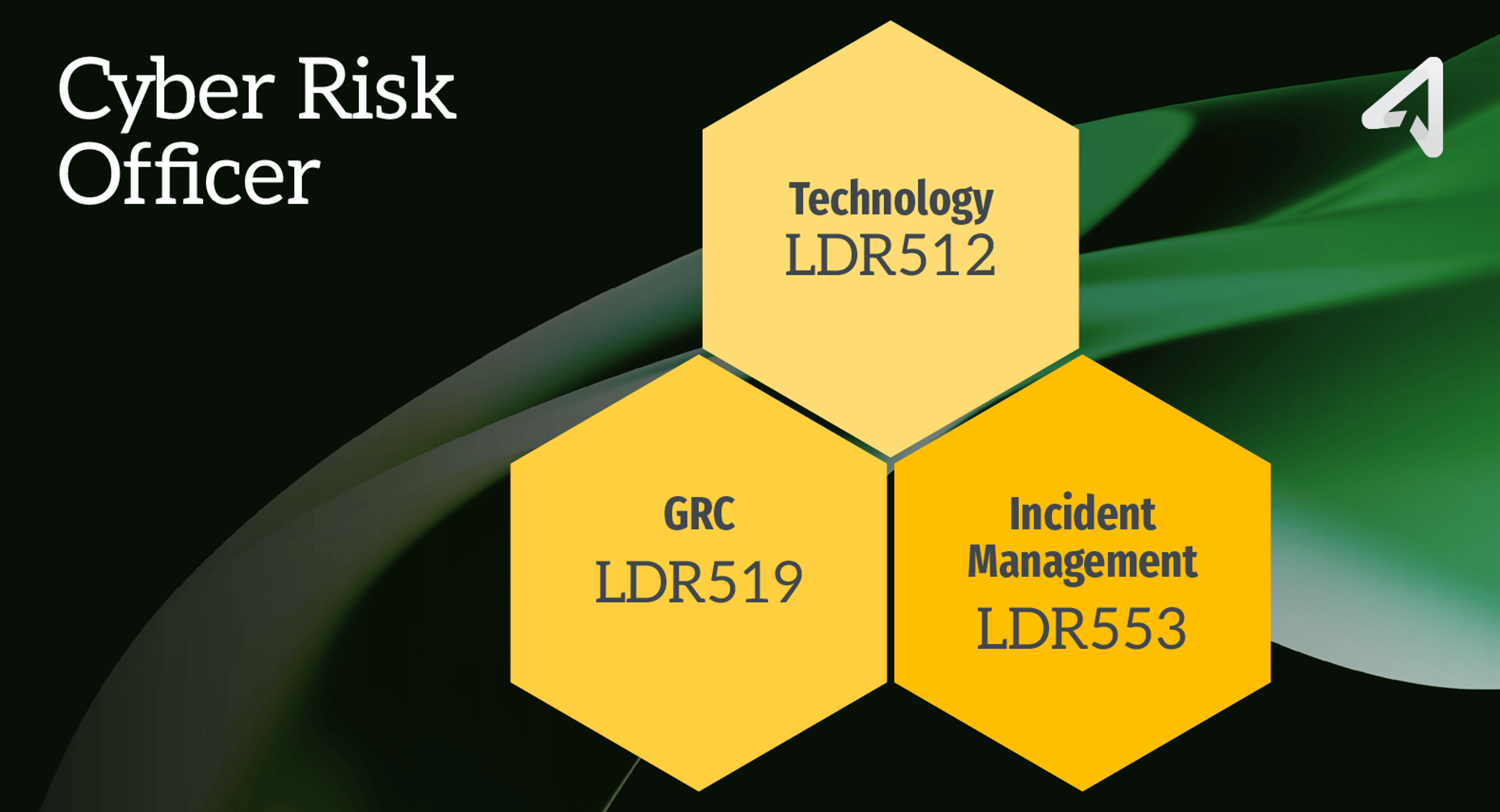
The Cyber Risk Officer triad—anchored by LDR512, LDR519, and LDR553—develops the capability to operate where cyber risk becomes a governance issue rather than a technical one. It strengthens enterprise context, formal risk discipline, and executive decision-making during crisis conditions when technical certainty is incomplete and accountability is visible.
Enterprise risk decisions require system-level perspective. Risk posture is shaped by how multiple security capabilities interact: architecture, identity, operations, compliance, incident readiness, and the dependencies between them. Leaders who lack cross-domain context tend to overweight what they know best and underweight systemic risk. That distortion matters at the governance level because it influences what gets funded, what gets deferred, and what exposure becomes normalized.
A risk leader needs to understand the security capability landscape well enough to ask better questions. Where are the major dependencies? Which weaknesses amplify exposure elsewhere? What gaps are structural versus temporary? Without that context, governance becomes either overly technical—lost in details—or overly abstract—reduced to generic risk statements that don’t guide decisions.
LDR512: Security Leadership Essentials for Managers builds the cross-domain understanding required to operate at this level. The course examines core security capabilities across the enterprise and how they interlock. For leaders in governance roles, this context improves judgment, reduces blind spots, and strengthens the ability to evaluate tradeoffs based on how the security system actually functions rather than how it is described in documentation.
Governance fails without structure. Many organizations maintain risk registers and compliance mappings, but those artifacts often exist alongside decision-making rather than informing it. Risks are recorded without clear ownership. Mitigations are listed without a measurable plan. Acceptance happens implicitly because nothing changes, not explicitly because leadership made a deliberate choice. When scrutiny arrives—audit, regulatory inquiry, customer requirement—the organization scrambles to explain a posture it never articulated.
Risk discipline requires repeatable mechanics. How is risk identified? How is impact evaluated? What assumptions are documented? How are controls mapped to obligations? How is progress tracked? How are exceptions handled? These are not paperwork questions. They determine whether governance is defensible and whether leadership can explain decisions coherently under scrutiny.
LDR519: Cybersecurity Governance, Risk, and Compliance (GRC) establishes this foundation in detail. The course strengthens structured approaches to risk analysis, compliance alignment, and defensible reporting. Leaders leave with clearer methods for documenting exposure, mapping mitigations, and communicating risk posture in a way that holds up—internally and externally. This discipline is what makes executive risk conversations actionable rather than performative.
Crisis compresses time and raises consequences. While technical teams focus on containment, eradication, and recovery, executives face a different set of decisions: operational continuity, legal obligations, regulatory reporting thresholds, contractual commitments, public communication, and reputational impact. These decisions often need to be made before full technical clarity exists. That is the reality of serious incidents today.
A common failure mode during high-stakes incidents is extreme defaulting. Leaders jump to binary actions without structuring options: shut everything down, disclose immediately, delay decisions until more is known. That posture increases uncertainty instead of reducing it. Instead, mature leadership in crisis is defined by option framing: viable paths forward, consequences of each, what can be decided now, what must wait, and what information is missing.
LDR553: Cyber Incident Management for Leaders helps shape this executive-level capability. The course focuses on consequence-based decision-making, stakeholder coordination, and structured communication during incident conditions. Leaders learn to present options, articulate tradeoffs, and recommend action aligned to enterprise priorities. In crisis, governance becomes visible. The quality of decision framing determines whether the organization stabilizes quickly or compounds impact.
Enterprise cyber leadership is defined by consequence and accountability. Leaders need the context to understand the system, the discipline to formalize risk posture, and the ability to guide decisions when time is limited and uncertainty is high.
The Cyber Risk Officer triad strengthens these capabilities directly. LDR512 builds enterprise-wide security perspective. LDR519 formalizes risk and compliance discipline. LDR553 develops executive incident management and crisis decision-making. Together, these courses prepare leaders to operate where cyber risk intersects directly with financial, operational, and strategic governance. Learn more about SANS’s leadership training curriculum here. Read the first blog of this three-part series. Read the second blog of this three-part series.
SANS Fellow Frank Kim helps to develop the next generation of CISOs and cyber leaders while teaching LDR512 and LDR514.
Read more about Frank Kim