SEC536: Adversarial AI - Penetration Testing AI Systems
SEC536Offensive Operations, Artificial Intelligence


Solve the challenges. Unlock up to 75% off.
Complete the CyberThreat 2026 pre-registration challenges to unlock 25%, 50%, or 75% off your ticket.
Save your Seat
Browse this year's lineup and activities and lock in your place at CyberThreat 2026.
Real-world case studies and technical insights from experts working at the forefront of cyber security. Explore state-sponsored threats, OT and critical infrastructure attacks, insider risk, and AI-driven threats, with up to 8 CPE credits across both days.
Take on the CyberThreat CTF and the digital badge challenge, two of the most technically demanding competitions in the industry. Put your skills and your team to the test, solve practical cyber challenges whilst strengthening cyber resilience.
Meet the people tackling the same cyber challenges you - red and blue teamers, researchers, security leaders and students working on similar problems. Compare approaches exchange ideas and build your technical network.
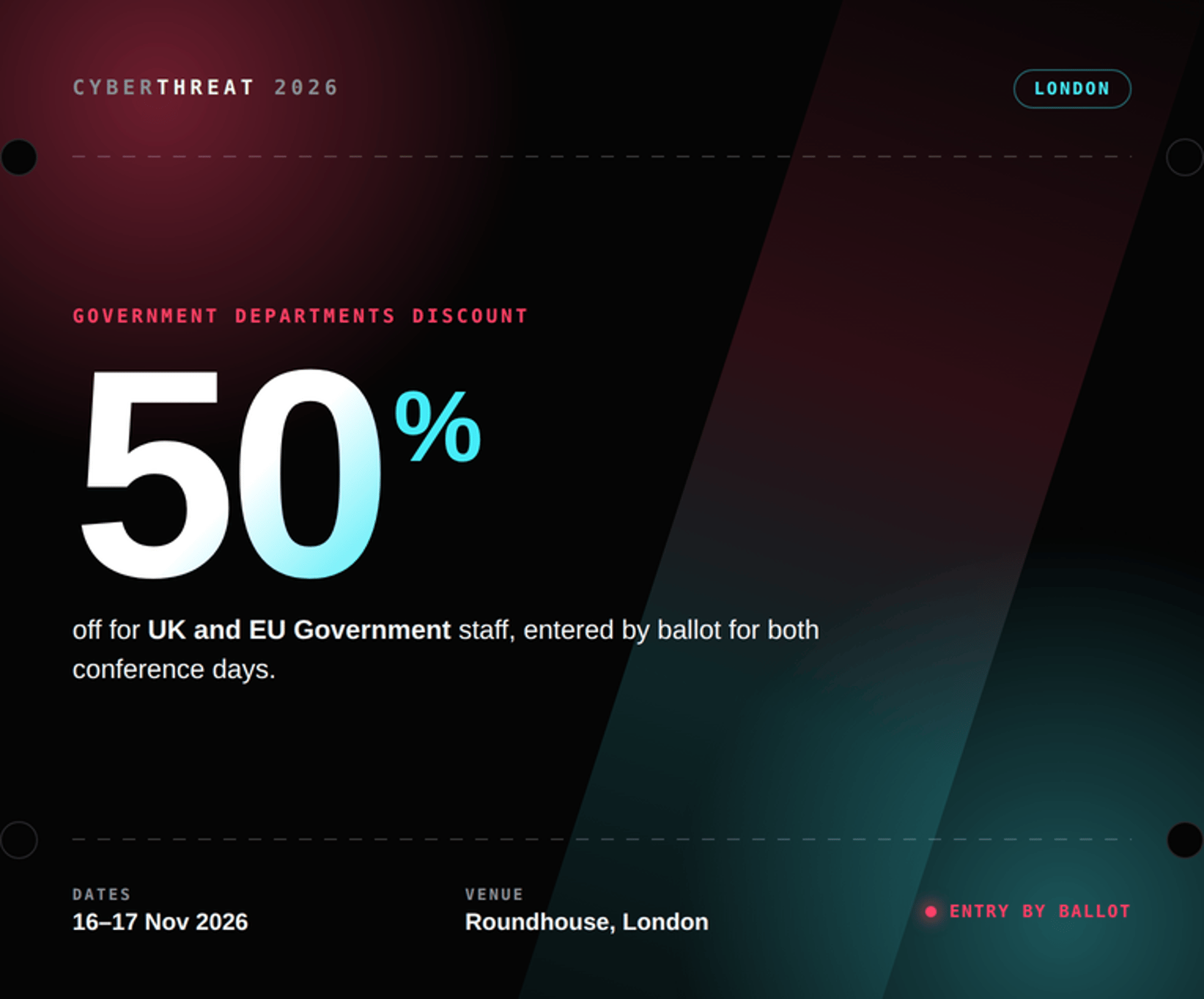
We are pleased to offer CyberThreat 2026, 16-17 November tickets to members of the UK and EU Governments at half the ticket price. Similar to previous editions, we are opening a ballot for members of the government. Through the form you will be eligible for 50% off. Use event code brisk-sand to get started.
You’ve got the skills? Well here's an opportunity to prove it and get a discount! Solve the pre-registration challenges and unlock 25%, 50% or 75% off your ticket to this years CyberThreat 26 event in London.
- Cyber and geopolitical conflict: The role of cyber operations in modern conflict, including nation-state activity, strategic competition, and related developments - Artificial Intelligence (AI): The evolving role of AI in cybersecurity, from threat actor use to defensive innovation and broader ecosystem impacts - Operational Technology (OT): Security challenges, emerging risks, and real world applications across industrial and critical infrastructure environments - Supply chain security: Addressing risks, trends, and approaches related to third party ecosystems, dependencies, and interconnected systems
- Red and blue teamers - CISOs and security directors - SOC analysts, threat intelligence and DFIR practitioners - Policy advisers, risk and compliance leads - Students and career starters
The CyberThreat CTF takes place across both days. Enter alone or build a team, then work through unpredictable challenges designed to reward outside-the-box problem-solving rather than familiarity with specific tools. Every paid delegate also receives a hackable badge, a physical device loaded with layered challenges that are guaranteed to be tough. Both competitions are open to all skill levels, with the CTF winners announced on stage at the end.



An iconic music and arts venue in Camden. Now it will be the host of CyberThreat 2026. Having hosted performances from Jimi Hendrix, Patti Smith and Pink Floyd during the 60’s & 70s. More recently, performances from Britney Spears, Radiohead, Janelle Monae, The Chemical Brothers and Wizkid have established the Roundhouse as one of London’s most memorable venues.


In-Person
In-Person
In-Person
Cybersecurity is going through changes…perhaps the biggest changes James has witnessed in 20+ years. AI, geopolitics, and more diverse targeting such as OT environments are rapidly rewriting the rule book for the industry. The hype is unrelenting and for many, the associated fatigue, too.
James will break down the critical risks ahead and what is changing. The good news? We have the talent and tools to fight back, and the cyber community remains our strongest weapon. Join us to uncover how we can make the lives of cyber criminals miserable.
In-Person
Malicious insiders are no longer isolated incidents. They've become a serious and growing threat across industries and geographies.
Drawing on years of incident response data, dark web research, and firsthand HUMINT and honeypot engagements, Thomas will explore how insider threats have evolved, why AI may be accelerating the risk, and what today's threat landscape looks like.
Through original research and real-world case studies, you will understand how malicious insiders operate, their tactics and techniques. What are the motivations behind insider-enabled attacks? How do criminal groups identify and exploit targets? What are the latest trends emerging from the dark web? Join us to explore one of cybersecurity's fastest evolving threats through the latest research and real-world findings
Thomas Mannie Wilkan, Head of Research – Lab-1
In-Person
In-Person
Operating an AI agent inside a live operational technology (OT) environment is fundamentally different from testing a web application. When the target is critical infrastructure, safety, operational context, and physical consequences become the defining constraints.
In this session, David shares the story of taking an Agentic AI Red Teamer beyond the lab and preparing it for deployment in a real wind farm, revealing how it was tuned to understand the environment, reason through IT and OT systems, and behave like a real adversary while operating within strict safety boundaries.
How did the agent approach its objective, map remote access and control paths and identify operational leverage? Where did it require human approval, what did find, and what did it refuse to do when the safety context changed? Join us to understand what agentic AI red teaming looks like when the objective has real-world physical consequences and safety is the first constraint, not an afterthought.
David Mound, Head of Research – Shinobi Security
In-Person
Sandworm has increasingly used trojanised software installers to compromise targets in Ukraine, turning trusted applications into malware delivery mechanisms.
This session shares new research, including the discovery of a previously unreported version of the Kalambur backdoor.
Through real-world investigations, you'll learn how these campaigns were uncovered, the techniques Sandworm uses for espionage operations, and the practical analysis methods that led to the discovery of new infrastructure and malware.
Tom P, Principal Intelligence Analyst – BAE Systems
In-Person
Famous Chollima, the North Korean threat actor behind the Contagious Interview campaign, has spent years targeting Web3 and cryptocurrency developers through recruiter-themed social engineering and trojanised coding assessments.
Based on two years of research spanning more than 2,000 malicious repositories and campaign variants, Parthiban examines how the group continuously evolved its obfuscation techniques, infrastructure, and infection chains in response to public reporting and disruption efforts.
Join us to explore how Famous Chollima has evolved its tradecraft over the past two years, through real-world artifacts, code snippets, infrastructure examples, and campaign timelines practical hunting and detection techniques.
Parthiban Rajendran, Threat Intelligence Lead – Atlassian
Shiva Palaniappan, Senior Security Researcher – Microsoft
In-Person
AI is transforming vulnerability discovery, enabling security teams to identify weaknesses faster than ever before. But as discovery accelerates, a new challenge has emerged: How do organisations prioritise and remediate vulnerabilities at the same pace?
This session explores why traditional vulnerability management approaches are struggling to keep up with AI-driven discovery. It identifies what organisations must do to close the growing remediation gap. The practical approaches to risk prioritisation, exposure management, and scalable remediation workflows will be examined.
What are the strategies for adapting vulnerability management to the AI era, reducing risk, and improving remediation outcomes in increasingly complex environments?
Sylvain Cortes, VP Strategy – Hackuity
In-Person
In-Person
What began as the investigation of a single compromised government IIS server uncovered a much larger espionage campaign. In this session, Eli will share the forensic investigation into Ink Dragon, a Chinese threat actor targeting government and telecommunications organisations across Southeast Asia and Europe, revealing how trusted infrastructure was used to conceal a multi-victim operational network.
Join us to follow the investigation as it unfolded, from the initial compromise and lateral movement to the discovery of an IIS-based ShadowPad relay and additional victims.
Through technical findings, malware analysis, memory forensics, and real-world investigative pivots, you will gain insight into the process behind uncovering a live espionage campaign and the techniques used to expand visibility beyond a single incident.
Eli Smadja, Director, Security Research - Check Point Software
In-Person
Russian state-sponsored threat actors are shifting from malware to identity-focused attacks, using techniques such as adversary-in-the-middle (AiTM) phishing, Device Code abuse, and code phishing to compromise accounts without relying on passwords.
Based on previously unreported investigations by Proofpoint, this session reveals how actors including UNK_SnakeBite and UNK_AcademicFlare build trust with targets, steal identities, and gain persistent access. You'll learn how these campaigns work, why they're effective, and the practical detection and defence strategies organisations can use to stop them.
Mark Kelly, Staff Threat Researcher - Proofpoint
In-Person
Russia’s full-scale invasion of Ukraine marked a turning point in the role of cyber operations in modern conflict. Cyberattacks have become a strategic instrument of warfare, supporting military objectives while targeting critical infrastructure, government institutions, and essential national services.
In this keynote, Ivan Kalabashkin will examine the evolving cyber threat landscape and Ukraine’s response to sustained nation-state cyber aggression. Drawing on Ukraine’s experience in detecting and responding to more than 16,000 cyberattacks and incidents, the keynote will explore how these events have shaped the country’s approach to cyber resilience.
What are the key lessons learned from defending against sustained cyber warfare? How do these experiences continue to inform Ukraine’s national cybersecurity strategy and resilience efforts?
Illia Vitiuk, Adviser to the Chairman– Security Service of Ukraine
In-Person
In-Person
In-Person
In-Person
On 29 December 2025, energy operators in Poland noticed brief but unexplained disruptions across their monitoring systems. What initially appeared to be a routine fault soon revealed the fingerprints of a coordinated cyberattack aimed at disrupting parts of the national grid.
Maciej Siciarek of CERT Poland, unpacks how the incident unfolded, tracing the attack’s progression, the key indicators found in industrial systems, and the steps taken to restore operations and strengthen defences, especially during a time of hybrid war. Join us to gain practical insight into the realities of defending critical infrastructure when digital intrusions disrupt real-world operations.
Maciej Siciarek, Director of CSIRT Division - NASK
In-Person
BlueNoroff has evolved its social engineering tactics into highly convincing, media-driven campaigns capable of compromising even security-conscious organisations.
This session will examine a real-world investigation into one of the group's fake meeting operations, revealing how carefully crafted deception, AI-generated content and rapid post-compromise activity combine to create an effective attack chain.
Drawing on forensic evidence and threat intelligence, Eoin will take you inside the campaign, exploring how the attack unfolded, the tactics employed by the threat actor, and the methods used to deceive and compromise victims.
The session will examine the evolution of modern social engineering techniques and the challenges they present to defenders. How do these campaigns operate in practice? How can you recognise the warning signs of similar attacks? What are the key considerations for improving detection, response and organisational resilience against increasingly sophisticated threat actors?
Eoin Healy, Principal Threat Researcher - Arctic Wolf
In-Person
Satellite receivers are often overlooked as a security risk, yet they present a unique and increasingly relevant attack surface. How would you approach a satellite receiver from an offensive security perspective? How would you extract the firmware, identify exposed interfaces, assess the RF attack surface, and uncover the weaknesses that can lead to compromise?
Through practical examples and a live demonstration, you will gain insight into the end-to-end process of identifying and exploiting vulnerabilities in a real satellite receiver.
Whether you are new to hardware hacking or looking to expand your offensive security skillset, this session will provide a practical framework for approaching embedded devices, along with techniques and lessons that can be applied to hardware security assessments more broadly.
Salman Shakeep Abulatif, Cybersecurity Consultant - ISKRA Protect
In-Person
In-Person
Garry Byrne, Head of Incident Investigation & Response - Tesco
In-Person
Telegram has become a key platform for cybercriminals to coordinate scams and process fraudulent payments at scale. But how do these payment ecosystems operate, and how can defenders identify and disrupt them?
Through a real-world case study, this session explores the infrastructure behind Russian-language Telegram payment gates, revealing the techniques used to map scam networks, trace payment flows, and uncover links between fraudulent operations using OSINT and threat intelligence.
You will leave with practical methods for investigating scam payment infrastructure, extracting actionable intelligence, and Improving detection and defensive reporting.
Adrian Dacka, Penetration Tester – Independent Security Researcher
In-Person
Cybersecurity practitioners are increasingly required to make critical decisions in environments shaped by uncertainty, evolving technologies, and rapidly changing threats. How are you to make effective decisions when the information is incomplete, dependencies are constantly shifting, and traditional planning no longer provides the answers?
In this session, we will explore how making sense of complexity can help security leaders navigate today's most challenging cyber problems, from AI governance and post-quantum readiness to supply chain risk and multi-vendor ecosystems.
Drawing on real-world experience, Anne will examine why treating complex challenges as merely complicated can lead to brittle decisions, and how alternative approaches can improve resilience and adaptability.
Anne Leslie, Head of Cloud Risk - IBM
In-Person
In-Person
As AI agents become embedded across organisations, the boundaries between human and machine identities are becoming increasingly difficult to distinguish. New opportunities are created for attackers to exploit trusted systems.
How can organisations secure identities in a workforce where humans and AI operate side by side?
Drawing on research and a supply chain case study, Anna will explore the emerging risks of human-AI identity, examining how compromised AI credentials can evade detection and enable lateral movement across enterprise environments.
What are the practical approaches to strengthening identity governance? How is anomalous AI behaviour detected?
Anna Lena Fehlhaber, Technology Strategy Lead AI/Cyber Security - Leibniz Universität Hannover
In-Person
In-Person
Some of the most significant OT cyber-attacks have achieved their objectives by abusing legitimate OT functionality rather than exploiting software vulnerabilities. As OT systems become increasingly connected and state-backed actors continue to target critical infrastructure, understanding this growing attack surface has never been more important.
This session introduces the concept of Living Off the Plant (LOTP) and explores how adversaries leverage native OT functionality to enable stealthy cyber-physical attacks that traditional IT techniques cannot achieve.
Join us to examine how LOTP challenges conventional OT security practices. Why can legitimate engineering activity be difficult to distinguish from malicious behaviour? What does this mean for modern OT threat modelling?
You will gain a deeper understanding of engineering-focused attack techniques, the role of engineering expertise in OT cybersecurity, and the limitations of existing security controls against adversaries abusing native OT functionality.
Ric Derbyshire, Principal Security Researcher - Orange Cyberdefense
In-Person
A journey over the last fifteen years looking at the evolution of state actors examining the impact of disruptive action, how the dependency of core malware has changed, the emergence of external support and what the future might look like. From the famous APT1 report through to criminal support to start via election interference and hijacking crime actor infrastructure.
How did we get from in-house rigid malware families to disposable malware? Key events have accelerated the evolution of state actors, whether that be disclosures, take downs or world events, but what impact did these events have? What lessons might we learn from this and what should we expect from the future?
Alex Clarke Smith, Principal Consultant - Google Threat Intelligence Group (Mandiant)
In-Person
In-Person
In-Person